Finland follows Moscow and St. Petersburg time.
Finnish clocks follow Russian time — one and a half hours ahead of the Sun in summer, and half an hour in winter.
Finland is following St. Petersburg time.
During winter time, Finnish clocks follow Saint Petersburg time — half an hour ahead of the Sun.
Finland is following Moscow time.
During daylight saving time, Finnish clocks follow Moscow time — one and a half hours ahead of the Sun.
Finland follows Russian time year-round
The winter time reference meridian passes through Saint Petersburg, and the summer time meridian lies approx. 500 km east of Moscow. In spite of this, Finland follows these two time zones. Maybe it's time for a change?
Winter time, or UTC+2, follows the 30°E meridian, which passes only through the easternmost parts of Finland, roughly on the Lieksa–Saint Petersburg axis. Summer time, or UTC+3, follows the 45°E meridian, which is far outside Finland's borders, about 500 kilometers east of Moscow.
Mainland Finland's borders lie between the 21°E and 31°E meridians. The reference meridian for the Central European time zone, UTC+1, follows 15°E. Western Finland is therefore closer to the time in Sweden and the rest of Europe than the time currently observed.
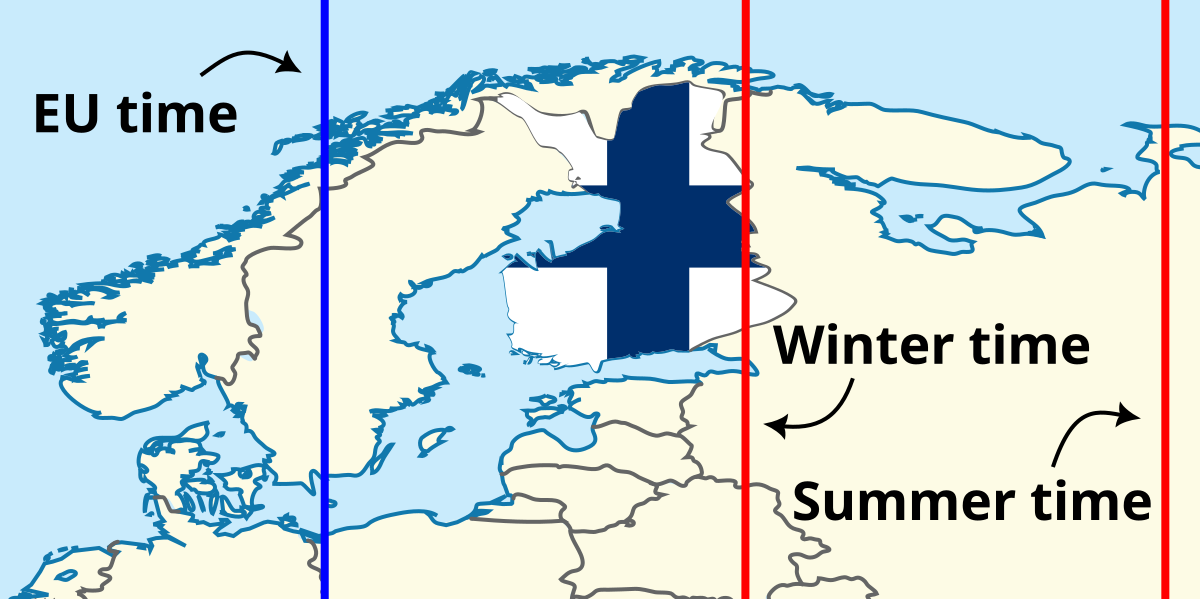
Map base: Wikimedia Commons / CC BY-SA 4.0
Nobody likes changing the clocks
Daylight Saving Time was conceived much further south than Finland in the late 19th century to shift daylight hours to the evening. In Finland, this makes little sense, as there is more than enough light during the summer anyway.
In 2019, the European Parliament voted by a clear majority to end the seasonal clock changes. However, progress stalled as the matter became stuck in the parliaments of member states. Finland has not yet made a decision either.
However, the decision must be made eventually. Staying on permanent summer time would be a poor choice for Finland, as it deviates drastically from our solar time. Even winter time deviates from solar time across most of the country. Both of the currently used time zones set us apart in time from the majority of the EU.
Since the system is being reformed anyway, why settle for just abolishing clock changes? It would be in Finland's best interest to finally stop following Russian time and move to a time zone that better reflects our geographical and political reality.
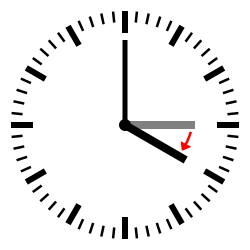
Finland is caught between time zones
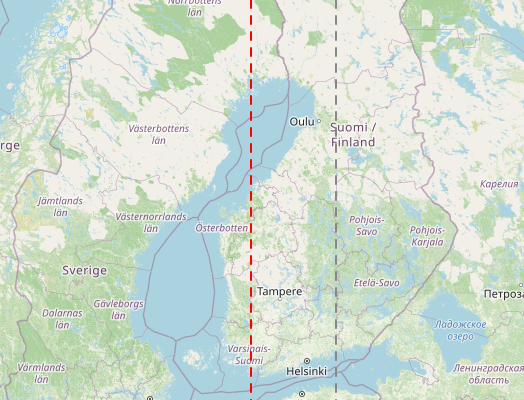
A half-hour time zone, UTC+1.5, would best correspond to Finland's geographical location. In this case, Finland would be half an hour ahead of Sweden.
The reference meridian for UTC+1.5 follows 22.5°E, passing slightly east of Turku. It is more accurate than UTC+2 for parts of Finland roughly west of Kouvola.
Half-hour time zones are unusual but not unheard of; they are observed in places like Canada, India, and Australia.
On this map, the red dashed line shows the UTC+1.5 reference meridian, and the gray dashed line indicates the point west of which UTC+1.5 is more accurate than UTC+2. Approximately 80% of Finland's population lives west of the gray line.
Unified EU, unified time
However, the smartest move would be to follow the same time zone as the majority of other EU countries. Finland's allies and trading partners are to the west, in the UTC+1 zone.
UTC+1 is more accurate than UTC+2 in the westernmost parts of Finland — west of UTC+1.5. Moving east from Turku, it begins to deviate from the Sun's position more than UTC+2. In terms of timezones, e.g. Tampere is UTC+1.58 and Helsinki is UTC+1.66. However, the Central European time zone has other aspects that compensate for the negative time offset.
Following the same time as other EU countries would be in Finland's interest, and a unified time zone would be a competitive advantage for the EU. In the current model, Finnish offices open and close an hour earlier than their Central European counterparts, and employees go to lunch at different times than their European colleagues. In a multinational economy, this adds unnecessary friction to daily operations and makes the overlapping part of workdays two hours shorter.
Today, cross-border friendships — primarily conducted over the internet — are also common. The time difference effectively eats away two hours of time available for these relationships.
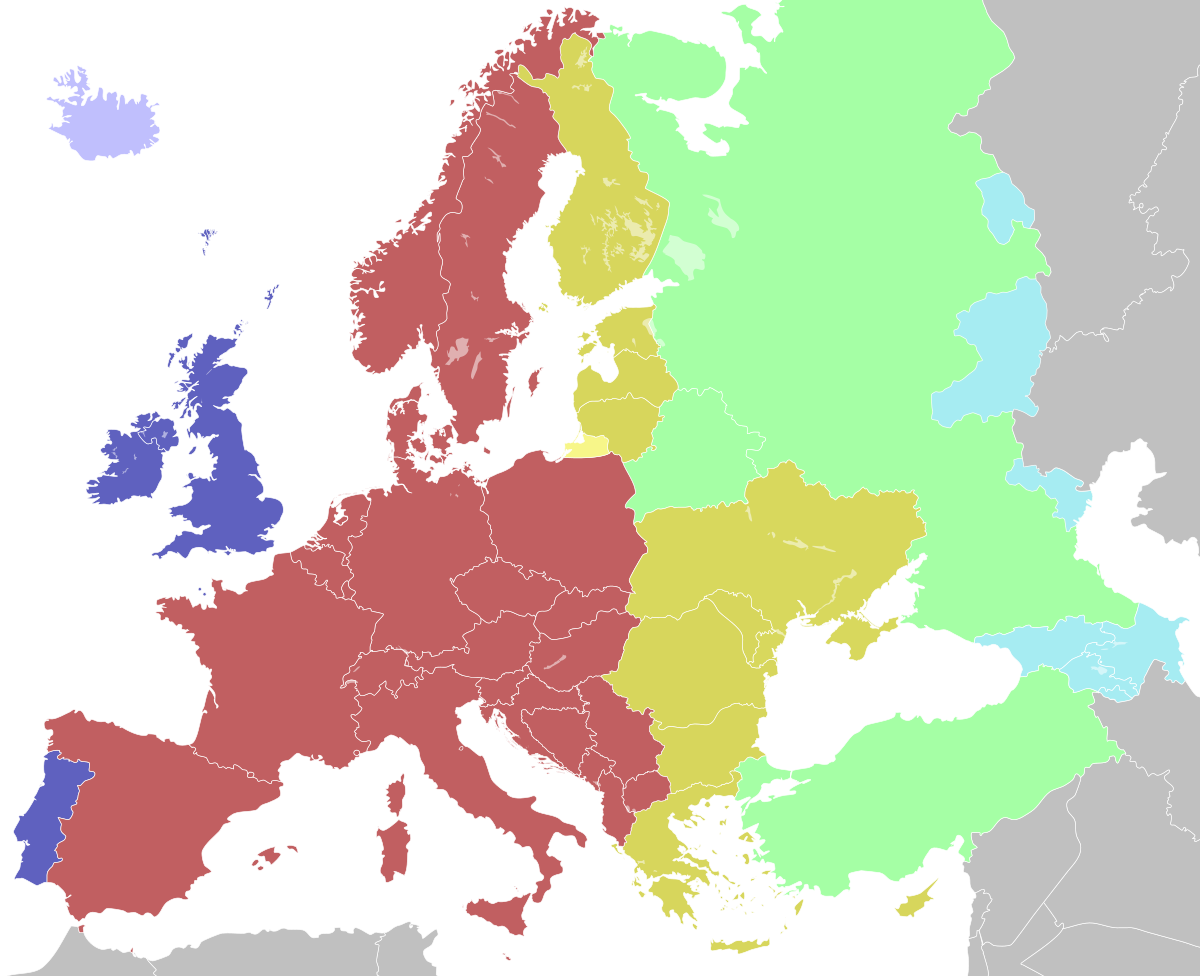
Map: Wikimedia Commons / CC BY-SA 4.0
The clock's divergence from the Sun
Following the wrong time zone means the clock time does not correspond to the actual time of day. Most of Finland is ahead of the Sun year-round.
Finland's time zone corresponds to the Sun's position in the sky only in the easternmost parts of Finland, and even then only during winter time. The further west you go, the more the clock is ahead of the Sun. Summer time disrupts the situation completely; in summer, Western Finland is 1.5 hours ahead of the Sun.
Living west of a time zone's reference meridian, as in Finland, pushes people to stay up later. The body's natural rhythm follows the movement of the Sun, and on the western edge of a time zone, the Sun sets later according to the clock. This phenomenon is called social jet-lag. According to research, it causes various health problems ranging from sleep deprivation to an increased risk of cancer.
Following EU time would have the opposite effect: clocks would run about half an hour behind the Sun. The Sun would set a bit earlier, which would be a nice thing during the bright evenings of summer. It would also rise a bit earlier, which would be an advantage during the dark mornings of winter.
Use the calculator to the side to see what time it should actually be in your city.
Select your nearest city, and the calculator will tell you what the time should actually be.
True timezone: UTC+0.00
Mean solar time is the time clocks would show if the reference meridian of their time zone passed directly through your city.
Apparent solar time is the time corresponding to the Sun's actual position; the time a sundial would show.
Due to the eccentricity of Earth's orbit and the tilt of Earth's axis, mean solar time matches apparent solar time only four times a year. In non-leap years, these days are April 15th, June 13th, September 1st, and December 25th.